

Castles in Poland: 8 Beautiful Polish Castles To Visit (Plus Other Famous Castles And Palaces)
The first time I walked into a Polish castle, I wasn’t expecting much. I’d grown up in Australia, where “historic” means something built before World War II. Then I moved to Poland, and within my first year, I found myself standing inside a 14th-century fortress that made every castle I’d seen in movies look like a garden shed.
Here’s what nobody tells you about castles in Poland: there are hundreds of them, they’re shockingly accessible, and most aren’t overrun with tour buses the way their German or French equivalents are. During my years living here, I’ve visited dozens of Polish castles on random weekends, dragged skeptical visitors to them, and watched their jaws drop when they realized what Poland has been hiding from the rest of Europe.
This guide covers the best castles in Poland that are actually worth your time. Not a vague list of “pretty buildings,” but the ones I’d tell a friend to prioritize if they had a week in the country and wanted to see serious medieval and Renaissance architecture. I’ll also show you how to string these places together from Warsaw, Kraków, or Gdańsk without blowing your budget or needing a tour group.
At EXPATSPOLAND, we write from the perspective of foreigners who actually live here. That means practical logistics, honest opinions, and a bit of context about why these places matter beyond the Instagram photos.
- Poland has hundreds of castles and thousands of palaces, but you only need a handful for an unforgettable trip.
- Malbork, Wawel, and Moszna do the heavy lifting for first-timers who want the famous Polish castles ticked off quickly.
- You can see serious medieval castles on day trips from Warsaw, Kraków, Gdańsk, and Wrocław without blowing your budget.
- If you fall in love with this stuff, Lower Silesia and the Eagles’ Nests Trail give you enough castles for many weekends.
Castles in Poland at a Glance
So how many castles are in Poland, exactly? The honest answer is: it depends on how you count.
According to official heritage statistics, Poland had 417 registered castles in its national register as of 2011, alongside thousands of palaces and manor houses. But those numbers shift depending on whether you include ruins, later historicist rebuilds, and buildings that are technically palaces but everyone calls “castles” anyway.
Zamek vs Pałac: What’s the Difference?
This is where things get interesting for visitors. In Polish, *zamek* means a fortified residence where defense was the primary function. Think thick walls, watchtowers, moats, and strategic hilltop locations. A *pałac*, on the other hand, is a luxurious residence built for comfort and showing off wealth, not for repelling invaders.
The complication? Many medieval castles were later rebuilt into palaces when their owners decided they’d rather have big windows and ballrooms than arrow slits. And some buildings that are architecturally palaces, like the famous Moszna, get called “castles” because they look like something from a fairytale.
When you hear about Poland having “500+ castles,” that figure often includes everything grand and historic. When you narrow it to actual medieval fortresses, the number drops. But here’s what matters: Poland has an extraordinary density of both, spread across distinct regions with completely different architectural styles.
The brick-Gothic fortresses of the Teutonic Order in the north look nothing like the limestone “Eagles’ Nests” in the south, which look nothing like the Baroque palaces of Lower Silesia. That variety is what makes castle-hopping here so rewarding.
8 of the Best Castles in Poland to Actually Visit
You could spend years chasing every ruin and restored fortress in this country. Here are eight I’d start with, the ones that deliver on both historical weight and visitor experience.
Malbork Castle: The Heavyweight of Polish Castles
If you only visit one castle in Poland, make it Malbork.
This is the world’s largest brick castle and one of the largest castles by land area, period. Built by the Teutonic Knights starting in 1274 and expanded into their headquarters from 1309, Malbork isn’t just big; it’s overwhelming. The complex consists of three connected castles (High, Middle, and Outer) surrounded by multiple defensive walls, and walking through it takes hours.
What strikes you first is the color. Millions of red bricks assembled into pointed Gothic arches, vaulted chambers, and fortress walls that seem to go on forever. I first visited in January, when snow was blowing sideways, and the emptiness made the scale even more impressive. In summer, expect crowds, but even then, there’s enough space to absorb everyone.
**Practical details:** Malbork is about 60 km from Gdańsk, reachable by train in under an hour. Plan at least half a day for the visit. The audio guide is worth it for understanding what you’re looking at.
Wawel Royal Castle in Kraków: Polish Statehood on a Hill
Wawel isn’t just a castle; it’s the symbolic seat of Polish monarchy and one of the country’s premier art museums. Perched on a limestone hill overlooking the Vistula River, this was the residence of Polish kings for over 500 years and remains the most emotionally significant historic site for most Poles.
The complex includes the Royal Castle with its Renaissance courtyard, Wawel Cathedral (where kings were crowned and buried), and the Dragon’s Den cave at the base of the hill. The State Rooms contain Sigismund II Augustus’s famous tapestry collection, and the armory has enough medieval weapons to arm a small crusade.
**Practical details:** Wawel anchors any Kraków visit. You could spend an entire day exploring the castle, cathedral, and hill, or do the highlights in 2-3 hours. Book tickets online in summer; the most popular exhibitions sell out. If you’re exploring Kraków more broadly, check out our guide to travel Krakow on a budget.
Royal Castle in Warsaw: The Rebuilt Heart of the Capital
Here’s something that changes how you see Polish heritage: the Royal Castle in Warsaw is almost entirely a post-war reconstruction.
The Nazis deliberately demolished it in 1944, reducing centuries of royal architecture to rubble. What stands today was painstakingly rebuilt between 1971 and 1984, using original fragments, historical records, and donated artifacts. On paper, it’s “not authentic.” In practice, no one in Warsaw treats it as a fake. It represents something more complicated: a nation’s refusal to let its identity be erased.
The interiors are impressive, full of original furnishings that survived the war, plus meticulous recreations of the royal apartments. The Canaletto Room is named after the 18th-century painter whose detailed Warsaw cityscapes helped guide the reconstruction of the entire Old Town.
**Practical details:** Located in Warsaw’s Old Town, the castle is easily accessible on foot from central hotels. Allow 2-3 hours for the interior. The square in front hosts markets and concerts throughout the year.
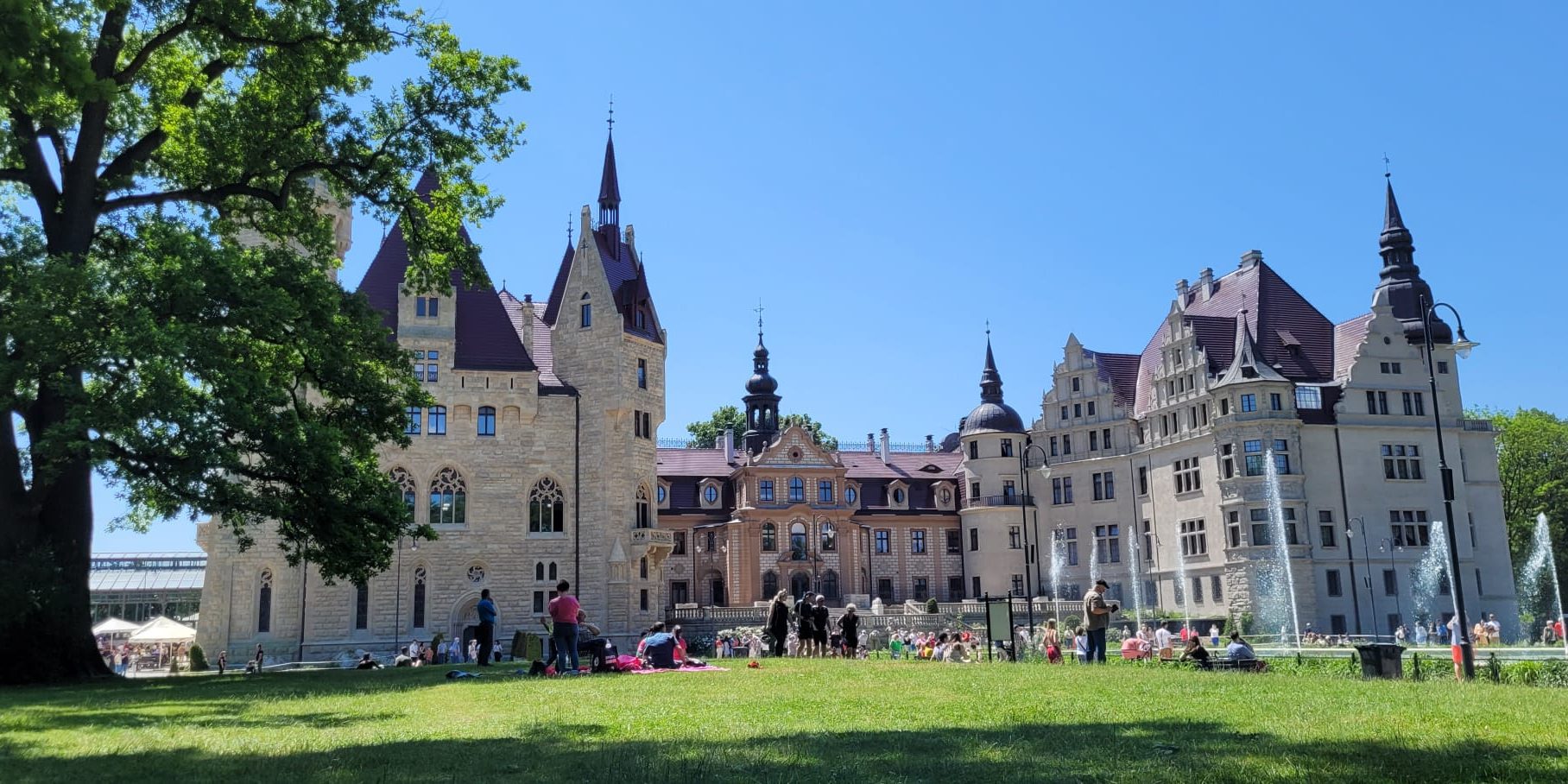
Moszna Castle: The “Fairytale” Polish Castle on Instagram
If you’ve seen a viral photo of a castle in Poland with an absurd number of towers, it was probably Moszna.
Technically, this is a palace, not a castle. It was never built for defense. But with 99 towers and 365 rooms, blending Baroque, Neo-Gothic, and Neo-Renaissance styles, nobody cares about the classification. The Tiele-Winckler family expanded the building throughout the 19th century into the fantasy-like structure that exists today. They fled the Red Army in 1944, and a small family cemetery in the nearby forest marks their final connection to the estate.
I visited Moszna on a rainy April afternoon, which honestly made it feel even more like a film set. The interiors are hit-or-miss; some rooms have odd modern art installations that feel out of place. But the exterior and the surrounding park are worth the trip.
**Practical details:** Moszna is about 30 km from Opole, which has train connections to Wrocław and other cities. You can stay overnight in the castle itself, which now operates as a hotel and restaurant. The azalea season in late May draws crowds.
Niedzica (Dunajec) Castle: Cliffs, Reservoir, and Rumours of Treasure
Niedzica Castle sits on cliffs above Lake Czorsztyn, a reservoir created by a dam on the Dunajec River. Across the water, you can see the ruins of Czorsztyn Castle, and the whole setting looks like something from a fantasy novel.
This picturesque 14th-century fortress was originally a Hungarian watchtower on the border with Poland, built by the Berzeviczy family. It changed hands multiple times over the centuries and now operates as a museum complex managed by the Association of Polish Art Historians.
Locals will tell you about the legend of Inca treasure supposedly hidden here, connected to a descendant of Incan nobility who allegedly married into a family associated with the castle. Is it true? Almost certainly not. But it’s a great story, and the museum plays it up appropriately.
**Practical details:** Niedzica is in the Pieniny region, close to Poland’s mountain regions and about 2 hours from Kraków by car. Many visitors combine it with a Dunajec Gorge rafting trip or hiking in the area. Allow 1-2 hours for the castle itself.
Pieskowa Skała Castle: Renaissance Elegance Near Kraków
If Malbork represents Gothic military power and Wawel represents royal prestige, Pieskowa Skała represents something gentler: a medieval fortress transformed into an elegant Renaissance residence.
Located in Ojców National Park, the castle sits above the Prądnik Valley near a dramatic limestone rock formation called Hercules’ Club. The building started as a 14th-century Gothic fortress and was converted into its current form in the 16th century. Today, it’s an official branch of the Wawel Royal Castle museum, housing collections of painting, sculpture, and decorative arts.
The arcaded courtyard is the highlight, a classic example of Italian Renaissance architecture transplanted to the Polish-Lithuanian Commonwealth. The interiors are smaller and more intimate than Wawel’s grand state rooms, which makes them easier to appreciate.
**Practical details:** Pieskowa Skała is about 25 km from Kraków. You can reach it by bus (with a short walk), but a rental car makes combining it with other Eagles’ Nests castles much easier. Allow 2-3 hours including the surrounding park.
Bobolice Castle: Eagle’s Nest with Legends and Witcher Vibes
Bobolice is one of the most photographed castles on the Eagles’ Nests Trail, and it’s also one of the most controversial among Polish heritage enthusiasts.
The original 14th-century fortress fell into ruin over the centuries, and what stands today is largely a private reconstruction completed in the 2000s. Some people love it; others argue it’s too clean, too much of a fantasy interpretation rather than a faithful restoration. I fall somewhere in the middle. The reconstruction makes the castle more accessible and visually dramatic, but you lose the sense of authentic decay that makes places like Ogrodzieniec so atmospheric.
The legends are excellent, though. Stories of a “White Lady” ghost, buried treasure, and secret underground passages have circulated for centuries. If you’re a fan of medieval-inspired Witcher lore, the dramatic limestone setting will feel very familiar.
**Practical details:** Bobolice is best combined with other Eagles’ Nests castles on a car trip from Kraków. The castle itself takes 1-2 hours to explore, including the tower climb.
Kwidzyn Castle: Teutonic Fortress with a Twist
Most people who visit northern Poland’s Teutonic castles focus on Malbork, but Kwidzyn offers something unique: a castle-cathedral complex connected by a striking covered bridge to a freestanding tower.
That tower was the castle’s latrine, and the architectural solution of putting it outside the main walls (for obvious sanitary reasons) created one of the most unusual silhouettes in European medieval architecture. The cathedral attached to the castle contains impressive Gothic frescoes and tombs.
Kwidzyn demonstrates the dual religious and military function of Teutonic Order architecture. These weren’t just fortresses; they were centers of religious life and administration for a monastic military order that controlled much of Prussia and parts of Poland for centuries.
**Practical details:** Kwidzyn is about 70 km south of Malbork and can be combined with Gniew Castle for a full-day northern castle loop from Gdańsk or Toruń. Allow 1-2 hours for the castle and cathedral.
Other Famous Castles and Palaces in Poland Worth a Look
If the eight above get you hooked, here are more I’ve either visited or flagged for future trips:
- Książ Castle (Lower Silesia): The third-largest castle in Poland, perched above the Pełcznica valley near Wałbrzych. The von Hochberg family owned it for over 400 years. Nazi tunnels underneath add a darker historical layer.
- Ogrodzieniec Castle (Silesian Voivodeship): The most famous ruin on the Eagles’ Nests Trail, perched on the highest hill of the Kraków-Częstochowa Upland. More atmospheric than Bobolice, but less restored.
- Czocha Castle (Lower Silesia): A dramatic medieval fortress above Lake Leśnia, now operating as a hotel. Frequently used as a film location in Polish cinema.
- Golub-Dobrzyń Castle (Kuyavian-Pomeranian): A Teutonic stronghold later remodeled into a Renaissance residence. Now hosts knight tournaments and cultural events.
- Łańcut Palace and Wilanów Palace: These sit firmly on the palace side of the spectrum, both are former aristocratic residences with world-class collections and landscaped grounds.
Polish Castles and Palaces by Region and Route
One of the best things about castle-hopping in Poland is how the landscape changes from region to region. Here’s how to think about it geographically.
Northern Brick Gothic and the Teutonic Castles
The Teutonic Order built dozens of brick fortresses across what is now northern Poland during the 13th and 14th centuries. These castles share a distinctive architectural style: red brick construction, pointed Gothic arches, massive scale, and layouts designed for both military and monastic life.
The Gothic Castles Trail links many of these sites across Pomerania, Warmia, and Masuria. Key stops include Malbork (the headquarters), Kwidzyn, Gniew, Lidzbark Warmiński, and Golub-Dobrzyń.
**Best base:** Gdańsk or Toruń. From either city, you can reach multiple castles on day trips by train or car. If you’re planning to explore this region seriously, consider renting a car in Warsaw and driving north.
The Eagles’ Nests Between Kraków and Częstochowa
The Trail of the Eagles’ Nests (Szlak Orlich Gniazd) is a signposted long-distance route running roughly 160-164 km through the Kraków-Częstochowa Upland. The castles along this trail were built primarily in the 14th century under King Casimir III (“the Great”) to defend the kingdom’s western frontier.
Unlike the brick fortresses of the north, these are limestone castles perched on rocky crags. Many are ruins, which gives the trail a wilder, more romantic character than the polished museum-castles elsewhere.
Key stops include Pieskowa Skała, Ogrodzieniec (the most famous ruin), Bobolice, Mirów, and Olsztyn (not to be confused with the northern city of the same name).
**Best base:** Kraków. With a rental car, you can string 2-3 castles together in a single day trip. Public transport is possible but slower and less flexible.
Lower Silesia: Poland’s Answer to a Loire Valley
Lower Silesia has the highest concentration of castles and palaces anywhere in Poland. The European Route of Castles and Palaces highlights this density, with dozens of historic residences within easy driving distance of Wrocław.
The architectural style here is more varied than in other regions, reflecting the area’s complex history under Piast dukes, Habsburg rule, and Prussian/German ownership. You’ll find everything from medieval strongholds to Baroque palaces to Romantic-era mansions.
Key stops include Książ Castle, Czocha Castle, and dozens of smaller manor houses and palace-hotels.
**Best base:** Wrocław. A “castle weekend” from the city could easily fill 2-3 days without repeating sites.
Southern Borderlands: Pieniny and Podkarpacie
The mountainous south of Poland has its own castle character, shaped by the historical border between Poland and Hungary. Niedzica and the ruins of Czorsztyn overlook Lake Czorsztyn in the Pieniny region. Further east, the Podkarpacie region has scattered fortresses and manor houses that get far fewer visitors than their northern counterparts.
**Best base:** Zakopane for the Pieniny castles (though it’s primarily a mountain resort town), or Nowy Sącz for a broader regional approach.
How to Plan Your Own Castle-Hopping Trip in Poland
Here’s how I’d approach it if you gave me four days in Poland and told me to maximize castles.
Decide Your Base City and Radius
Your starting point determines which castles are realistic day trips:
- From Warsaw: Royal Castle and Wilanów Palace are in the city. Further afield: Malbork (long day trip by train) and northern castles.
- From Kraków: Wawel is the anchor. Easy access to Pieskowa Skała, the Eagles’ Nests Trail, and southern borderland castles.
- From Gdańsk: Malbork is the obvious priority. Gniew, Kwidzyn, and other Teutonic castles within 90 minutes.
- From Wrocław: Lower Silesia’s palace-and-castle circuit, including Książ, Czocha, and others.
If you’re trying to decide whether to base yourself in Warsaw or Krakow, Kraków wins for castle access if you’re focused on medieval fortresses and the Eagles’ Nests.
Train vs Bus vs Rental Car
**Train:** Best for single-destination trips like Warsaw to Malbork. Comfortable, reliable, and reasonably fast.
**Bus:** FlixBus and Polski Bus cover many routes but aren’t always convenient for castle locations, which tend to be in smaller towns.
**Rental car:** The clear winner for flexibility, especially on the Eagles’ Nests Trail or Lower Silesia circuit. Polish roads are generally good, signage is clear, and parking at castles is rarely a problem.
I’ve done all three. For Malbork alone, the train is perfect. For stringing together multiple Eagles’ Nests stops, a car is essentially mandatory unless you’re prepared for complicated bus schedules.
How Much Time to Allow Per Castle
- Malbork: Half-day minimum, full day if you want the complete experience.
- Wawel: Half-day for the castle and cathedral; full day if you add the museum exhibitions and surrounding hill.
- Smaller castles (Kwidzyn, Niedzica, Bobolice): 1-2 hours each.
- Ruins (Ogrodzieniec): 1-2 hours for exploring and photography.
Rough Costs
Castle entry fees in Poland are very reasonable by Western European standards. Expect to pay somewhere between 20-60 PLN (roughly €5-15) for most sites. Malbork and Wawel are at the higher end; smaller castles cost less. Many offer discounts for students and seniors. Always check official websites for current prices before visiting.
Sleeping in or Next to a Castle in Poland
Yes, you can sleep in castles and palace-hotels in Poland, and it doesn’t always cost five-star money.
Several castles have been converted into hotels or have hotels built into their grounds:
- Moszna Castle: The castle itself operates as a hotel with restaurant. Rates vary widely by season and room type.
- Czocha Castle: Another hotel-museum combination, with overnight stays available.
- Gniew Castle: A castle-hotel complex that also hosts historical reenactments and events.
- Various Lower Silesian palaces: The European Route of Castles and Palaces lists several palace-hotels in the region.
Don’t expect modern hotel standards. These are historic buildings with thick walls, uneven floors, and sometimes quirky plumbing. But the atmosphere makes up for it, there’s nothing quite like waking up in a 15th-century fortress.
Legends, Ghosts, and Strange Stories from Polish Castles
Polish castles come with centuries of accumulated folklore, and the stories are half the fun.
**The White Lady of Bobolice:** One of Poland’s most famous ghost stories involves a spectral woman in white haunting the ruined walls. Various versions identify her as a murdered bride, a cursed countess, or a victim of 17th-century wars. The reconstructed castle leans into the legend with atmospheric lighting and storytelling.
**The Inca Treasure of Niedzica:** According to legend, a descendant of Incan nobility fled Peru with a fortune in gold and eventually married into a family connected to Niedzica Castle. Treasure hunters have searched the castle and surrounding area for decades. No gold has been found, but the story persists.
**The Wawel Dragon:** Below Wawel Hill lies the Dragon’s Den, a cave associated with Poland’s most famous dragon legend. Supposedly, a dragon terrorized Kraków until a clever shoemaker’s apprentice killed it with a sheep stuffed with sulfur. Today, a fire-breathing statue at the cave entrance entertains tourists. It’s cheesy, but kids love it.
These legends aren’t meant to be taken literally, but they add texture to visits. If you’re interested in Poland’s broader myths and legends, castle visits offer a great entry point.
FAQ About Castles in Poland
How many castles are in Poland?
Poland has approximately 417 registered castles according to official heritage statistics, plus thousands of palaces and manor houses. The exact count varies depending on whether you include ruins, later rebuilds, and buildings that are technically palaces but commonly called castles. Different sources cite different numbers because the definition is debated.
What is the most famous castle in Poland?
Malbork Castle is the most internationally famous, recognized as the world’s largest brick castle and a UNESCO World Heritage Site. For Poles, Wawel Royal Castle in Kraków holds deeper national significance as the historic seat of Polish kings.
What is the largest castle in Poland?
Malbork Castle is the largest, both as the world’s largest brick castle and one of the largest castles by land area globally. The complex covers approximately 21 hectares and took over 130 years to complete.
Can you stay overnight in a castle in Poland?
Yes. Several Polish castles operate as hotels, including Moszna Castle, Czocha Castle, and Gniew Castle. Lower Silesia has multiple palace-hotels as well. Prices vary from mid-range to luxury depending on the property and season.
Which medieval castles in Poland are easiest to visit without a car?
Wawel Castle (central Kraków), the Royal Castle in Warsaw (Old Town), and Malbork Castle (direct train from Gdańsk) are all easily accessible by public transport. Pieskowa Skała can be reached by bus from Kraków with a short walk, though it’s more convenient by car.
What is the “waterfall castle in Poland” I keep seeing online?
This phrase often refers to Niedzica Castle, which sits above Lake Czorsztyn and the dam on the Dunajec River. The dramatic water-and-cliff setting makes it highly photogenic, but it’s not technically a “waterfall castle” in the classic sense. Different viral posts sometimes point to different sites, so cross-check photos before planning a visit.
Make Your First Castle Trip Count
Poland’s castle landscape is one of Europe’s best-kept secrets, but it won’t stay that way forever. More travelers are discovering what expats living here have known for years: this country has world-class medieval architecture, and you can see it without fighting crowds or paying Western European prices.
Start with Malbork if you want the single most impressive site. Start with Wawel if you’re basing yourself in Kraków and want royal history alongside city exploration. And if you get hooked on this stuff, the Eagles’ Nests and Lower Silesia will keep you busy for many weekends to come.
At EXPATSPOLAND, we keep covering the practical side of exploring Poland. Whether you’re visiting for a week or settling in Poland for the long haul, these castles will change how you see the country.
—
**Meta Title:** Castles in Poland: 8 Best Polish Castles to Visit
**Meta Description:** Discover the best castles in Poland with this practical guide. From Malbork to Wawel, learn which famous Polish castles are worth your time.
