


When you think of Poland, the striking red and white of the Polish flag often springs to mind.
More than just a bold design of two colours, this state flag is a colossal source of national pride, symbolising a history that spans centuries of struggle, wars, revolutions, and a steadfast journey towards sovereignty and unity.
The Polish flag, with its own national day and specific rules for use, even in funerals, is far more than mere decoration. It has been the reason for both celebration and controversy, having landed people in prison for its misuse.
But what truly lies behind this emblematic symbol?
In this article, we invite you to explore the profound depths of the Polish flag’s story.
From its historical origins to the modern-day, we will uncover everything you’ve ever wanted to know about Poland’s flag, revealing its unique narrative and the enduring significance it holds for the Polish nation.
What does the Polish Flag look like?
The Polish flag is pretty straightforward: two horizontal stripes, equal in size. The top stripe is white, and the bottom one is red.

The Polish flag, with its distinct red and white hues, has a storied past deeply rooted in the nation’s history and legends. .
Origins & History of the Polish Flag
Tracing this history reveals not just a flag’s evolution, but also the cultural and political shifts that shaped Poland.
Medieval Beginnings and Symbolic Eagles
The story of the Polish flag unfolds in the Middle Ages, intertwined between the legends of the Piast Dynasty and Lech, a fabled founder of Poland.
The story of Lech and his brothers founding 3 countries as they travelled east is known to be the legend that started Poland. They 3 brothers set up camp for the night, and Lech saw a white eagle stand up in it’s nest, unfurl it’s wings as the sun was settling, creating a red and white backdrop. It’s here that he setteled Gniezno, Poland’s first capital.
But that also overlaps with the history of the Piast Dynasty, the first ruling dynasty of Poland. The first Monarch, Duke Mieszko I, baptised Poland, and decided on Poland’s flag and coat of arms based on his dynasty’s heraldry:

Royal Banners and Christian Influence
As Poland embraced Christianity in 966 under Mieszko I, a transition from pagan symbols to Christian emblems began. Early Polish standards weren’t flags as we know them but banners symbolising pride and identity. King Boleslaus the Generous and King Vladislaus the Elbow-High (yes, that’s his real name) were pivotal in defining these royal banners.
Vladislaus, in particular, stamped a decisive identity on the flag, choosing a red cloth with the white eagle for the Polish hussars.

This emblem transcended its role as a mere symbol, accompanying Poland in royal events and battles, and has even found its way into modern narratives like The Witcher series.
The Emergence of Red and White
Fast forward to 1792, during the first anniversary of the Constitution of 3 May 1791. This marked the first significant use of the red and white colour combination as a symbol of Poland.
Women adorned in white dresses with red ribbons and men wearing white-and-red brassards showcased a burgeoning sense of national identity. By the November Uprising of 1831, these colours had evolved into a national symbol, even though the Kingdom of Poland’s Sejm had only regulated the use of the military cockade at that time.
This image captures Kościusko’s daring charge, the emblematic cockade firmly in place:

19th Century: A Symbol Beyond Borders
Throughout the 19th century, the red-and-white emblem gained prominence beyond the Republic of Poland. Soldiers during the Springtime of Nations in 1848, as well as supporters of Polish independence, wore these colours proudly.
Notably, Polish soldiers displayed red and white cockades, a vivid affirmation of their nationality and allegiance.
Official Recognition and Legal Codification
It wasn’t until 1919 that red and white were officially recognised as Poland’s national colours, formalised in the laws about the national coat of arms and colours of the Polish Second Republic.
This law specified the flag’s design – a rectangle with two horizontal stripes, white on top and the red stripebelow, and set the aspect ratio at 5:8.

These dimensions, defined in the Polish Constitution and the 1980 law on national symbols, have remained unchanged, a testament to the enduring importance of the flag in Polish national consciousness.
Fun Facts about the National Flag of Poland
Many national flags have rules around their use, and Poland is no different.
- When displayed vertically, the white stripe of Poland’s flag should be positioned on the left.
- The flag is required to be raised before 8 am and lowered before sunset.
- If the flag is flown at night, it must be illuminated.
- Authentic national flags must not have any inscriptions or emblems unrelated to national symbols; however, cloth with different dimensions bearing logos, such as sports teams, is permissible but not advisable for frequent use.
- Respectful handling of the flag is legally mandated, including keeping it clean, ironed, and away from the ground or water.
- In adverse weather conditions, the flag should be folded and stored until conditions improve.
- Public desecration or destruction of the national flag is a legal offence, punishable by fine or imprisonment.
- The law allows the flag with the coat of arms to be flown at consulates, airports, and on merchant ships.
- The Polish flag has specific colours and dimensions and must be displayed on a flagpole; improvised versions like a simple cloth or drawn on paper are not official flags.
- A damaged flag should not be discarded casually; it must be destroyed by first ripping it in half to separate the colours, and then burning it.
- A flag featuring the coat of arms of Poland is not considered a standard national flag.
- On a coffin, the flag is arranged so that the white stripe is over the heart.

Flag Usage in the Military
The outbreak of World War II in 1939 marked a dark chapter in Polish history with the Nazi invasion. Interestingly, the Polish military largely refrained from displaying the red and white on their uniforms during this period.

However, these very colours became emblems of defiance and triumph across Europe and North Africa.
The Flag in European and North African Battles
Throughout the war, the Polish flag emerged over various battlefields, often following significant victories involving Polish forces.
A poignant instance was at the ruins of Monte Cassino abbey on May 18, 1944.
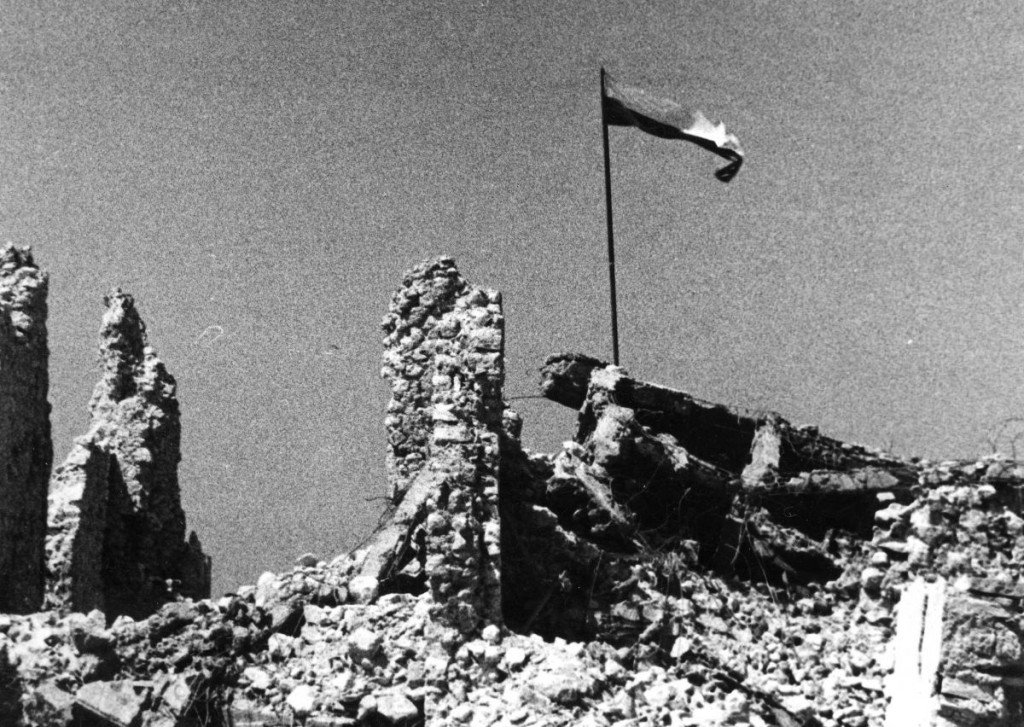
After a fierce battle, Polish soldiers hoisted their flag atop the abbey, a powerful symbol of their victory over German forces.
The Battle of Berlin and the Polish Flag
Fast forward to May 2, 1945, in Berlin, the Polish flag played a symbolic role in announcing the end of Nazi rule. As the Battle of Berlin concluded, three Polish battalions raised the red and white flag on the Berlin Victory Column.

This act signalled that the Third Reich’s capital was now under Allied command, marking a significant moment in the war’s closing stages.
The Warsaw Uprising: A Display of National Unity
The Warsaw Uprising in 1944 was a defining moment for the Polish flag and its national colours. During the intense 63-day conflict, the Home Army, alongside brave civilians, adopted the red and white as a unifying symbol of their resistance against Nazi oppression. The colours were prominently displayed on armbands worn by fighters and civilians alike, symbolising their collective struggle.

In a striking visual, some Poles reinvented Nazi-style helmets by boldly painting them with red and white stripes, often accompanied by the revered white eagle.

This act of defiance transformed a symbol of oppression into one of resistance.
The narrative of the Warsaw Uprising reached a climax on January 17th, 1945. As the Home Army, assisted by Soviet Forces, reclaimed the city, the Polish flag was unfurled above the battered Dworzec Centralny, standing as an unwavering emblem of national resilience and victory amidst the ruins.
The Polish-Soviet War and World War I’s Western Front
The symbolism of the Polish flag and its colours was not confined to World War II. During the Polish-Soviet War from 1918 to 1921, freedom fighters also donned armbands bearing the national colours, uniting in their fervour against the Soviets.
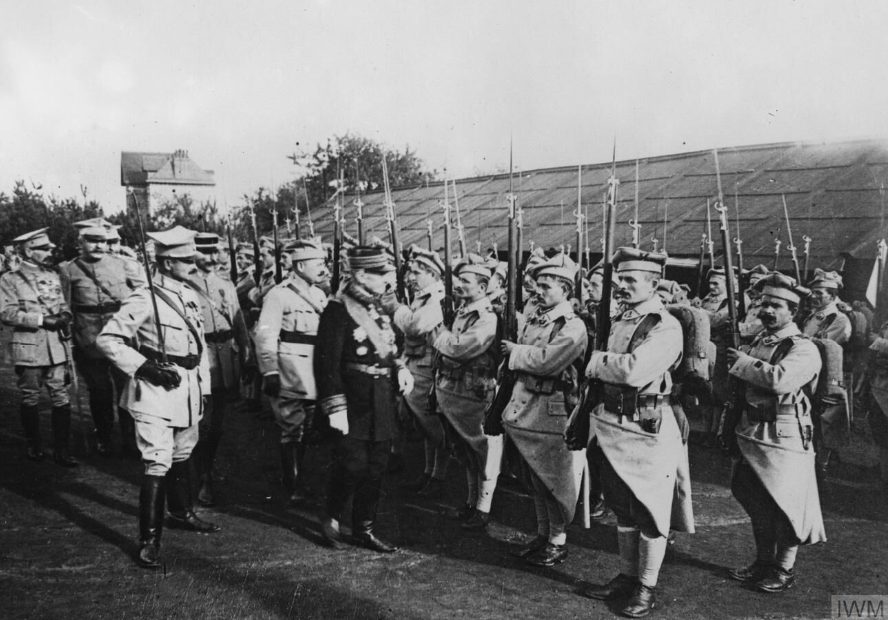
Furthermore, during World War I, Poles fighting alongside the French army on the Western Front honoured their heritage by wearing distinctive square hats, a nod to Polish military tradition, albeit without explicit Polish insignia.
The Polish Flag Under Communism
During the era of communism, the Polish flag stood as a symbol of unwavering tradition and national identity, despite the shifting political landscape that swept across Eastern Europe.
This period saw the flag becoming an emblem of resistance and a testament to Poland’s enduring spirit.
In a time when many nations under Soviet influence incorporated communist symbols like the red star, hammer, and sickle into their flags, Poland’s flag remained distinct.
This steadfast adherence to its original red and white design set it apart from countries like Albania and Romania, which altered their flags to reflect communist ideologies.

Poland’s flag, free from any socialist emblems, remained an enigma in the history of communist Europe, a symbol of the nation’s resilience under Soviet dominance.
However, the period was not without its scars. A notable instance of Soviet influence was the alteration of the Polish Coat of Arms.
The traditional symbol, the Polish Eagle, which had long been a beacon of national pride, suffered an indignity. Its regal crown was removed, symbolizing Poland’s subjugation under Soviet control.

This change to the coat of arms was a stark contrast to the unaltered state of the flag, highlighting the complex interplay of national identity and political influence during this time.
The Solidarity Movement and the Church’s Role
The importance of the Polish flag surged during key moments of resistance against communist rule, particularly during the Solidarity movement. This period saw the Church playing a pivotal role in pushing for the upheaval of communism.
A notable moment was the 1956 Poznań riots, where demonstrators wielded flags stained with blood.

This powerful imagery underscored the depth of the Polish people’s defiance against the oppressive regime. The flag, in these instances, transcended its symbolic role, becoming a rallying point for those seeking freedom and democratic reforms.
Colour specifics
Historically, Poland’s flag has consistently featured red and white, but the specific tones of these colours have shifted over time. Initially, the red on the Polish flag bore a crimson hue. However, following the January Uprising, this was replaced by amaranth, a deeper red.

The year 1921 marked a return to crimson, only for it to be replaced again by vermilion, a brighter red, a few years later. It wasn’t until the late 20th century that the colour darkened once more.
The white, often perceived as pure white, actually has a subtle silver tinge, adding depth to the flag’s appearance.
The Evolution of Legal Definitions
The precision in defining these colours took a considerable amount of time to establish.
For instance, the National Cockade Act of Poland, which outlined the rules for using national symbols, initially did not specify the exact shade of red.
Similarly, the Coat of Arms Act of the same era left the precise red hue representing Poland undefined.
In 1921, a significant step was taken when a government pamphlet recommended using ‘Crimson’ for the flag.
This recommendation, while not immediately formalized into law, began to shape the standard for the flag’s colours. It wasn’t until 1955 that this shade of red gained official recognition through a presidential decree.
Formalizing the Colours
The journey towards a legally codified colour palette culminated in 1980 with a revised version of the act. This revision reintroduced a shade closer to the original crimson and established official tri-chromatic values for the flag, ensuring consistency and precision. These values are now defined as:
- Hexadecimal: #dc143c
- RGB: (220, 20, 60)
- CMYK: 0, 0.909, 0.727, 0.137
Flag Variants
The simplicity of The Republic of Poland’s national flag means it’s quite simple for it to modify for specific governmental or military purposes.
Below you can see the flag for the Polish Land Forces and how it uses the same colour, red, as the flag.

Here’s the Airforce Insignia of the Polish Airforce. It uses the same colours as the flag and was made famous by Polish Fighter Pilots during the Battle of Britain.

Many cities in Poland also use the simple two-stripe design. Below, you can see a yellow and red Polish flag, the official flag of Warsaw:

And the flag of Krakow:

The flag of Torun:

And the flag of Katowice:

So, as you can see, the national flag sets the theme for the flags of many other Polish cities.
Legal Significance and Regulations
In Poland, the national flag is far more than just a piece of fabric with colours. It represents a deep-seated national respect and pride.
Legally, any act of disregard, damage, or unauthorized removal of the flag is not just frowned upon; it’s a legal violation that can result in hefty fines or imprisonment for up to a year.
This legal framework emphasizes the seriousness with which Poland views its national emblem.
For instance, between 2003 and 2004, there were 139 recorded instances of such flag-related offences, highlighting the vigilance with which these laws are enforced.
Evolution of Legal Usage
The Coat of Arms Act in Poland permits the display of the flag by all citizens, but the emphasis on respect is paramount. A significant legal change occurred in 2004, allowing the Polish flag to be flown beyond just national holidays.
Although this law was often loosely observed even before its formal enactment, it marked a shift towards a more open expression of national pride.
During the period from 1955 to 1985, the use of national symbols without authorization was a punishable offence.
This restriction was largely due to the communist party’s control over national symbols. As a result, unauthorized displays of the flag often became silent acts of defiance against the regime.

This spirit of resistance was notably encapsulated in the logo of Solidarność (Solidarity), where the flag is prominently featured, symbolizing the movement’s struggle for freedom and rights.
Similar Flags Around the World
Interestingly, several other countries have flags similar to Poland’s, featuring the same white and red colours.

Indonesia and Monaco, for instance, have flags that are essentially the inverse of Poland’s flag.
This similarity was humorously noted during a joint naval exercise between Polish and Indonesian officers, where the flags’ resemblance was apparent.

The Polish flag’s influence or resemblance can also be seen in local and regional flags around the world. These similarities, while sometimes coincidental, underscore the universal appeal and simplicity of the red and white colour scheme in vexillology.







Interesting!
Well not really a copycat, every country has their own version of history,
The Classic Indonesian Kingdom of Majapahit is known to use the Red and white stripes in the year 1293 to fight off the Yuan of China-Mongol Dynasty, need proof?
what do you think Polish do at that time?
They are still a subject of Roman Empire or heathen or even a barren land? Can we safely assume that polish is a copycat? Keep up the good work!